May 6, 2026 / 4 min read
Topics
Mystery ShoppingBrand Experience

Topics
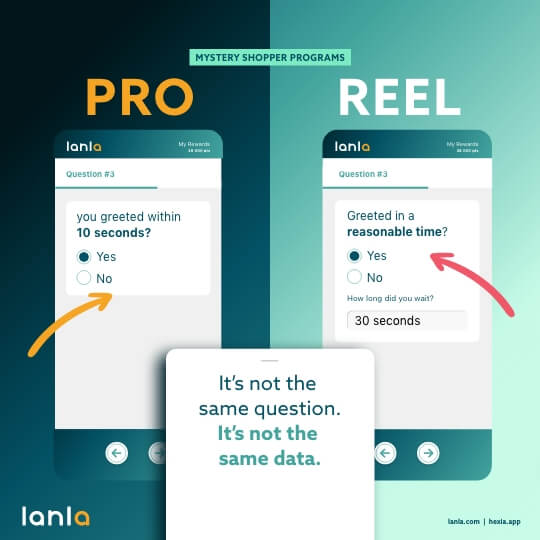
In professional-type programs, evaluators are salaried employees. They can complete a large number of missions per week across a variety of contexts. Their role is to verify whether the company’s operational standards are being met. They’re not asked to have genuine purchase intent: they’re asked to validate standards.
This type of program is particularly relevant for companies in a standardization or rapid expansion phase. When opening new locations and ensuring every branch follows the same procedures, the professional mystery shopper is a rigorous and effective tool.
Sample questions: professional-type mystery shopper
“Were you greeted within 10 seconds?” (Yes / No)
“Were any ceiling lights burned out?” (Yes / No)
“Were the store hours posted at the entrance?” (Yes / No)
Download our full white paper on the real consumer-type mystery shopper:
advantages, disadvantages, and implementation keys included.
In real consumer-type programs, evaluators are voluntary consumers. They’re not employees: they accumulate points (compensation that does not equal the purchase amount) in exchange for missions. They are real people, recruited for their consumer profile, with genuine purchase intent for the mission they’re given.
This genuine purchase intent makes it possible to go beyond standard verification. The mystery shopper can be asked to judge based on their own experience: were they greeted in a reasonable amount of time? Did the employee address their objections convincingly? These questions combine the standard and the customer’s perception.
Sample questions: real consumer-type mystery shopper
“Were you greeted in a reasonable amount of time? Please indicate how long you waited.”
“Did the employee address your objections? What was their most convincing argument?”
It’s not the same question. It’s not the same data. The alignment between your performance and your customers’ satisfaction will depend on it.
Christian Watier, Chief Scientific Officer, Lanla
At Lanla, we use both types of programs, based on the nature of the mandate and the client’s objectives.
The professional program is often the starting point for growing organizations: it ensures standards are applied consistently across a network that is standardizing and/or expanding. It’s a solid foundation. It’s also relevant in contexts where the required mystery shopper profile is very specific, or where the goal is to verify a legal standard.
The real consumer program is preferred where the overall client experience needs to be measured: retail, food service, financial services, hospitality, pharmacy, and more. These are the contexts where the perceptual dimension makes the most meaningful difference. It’s well known, it’s not only what you do for the customer that matters, but also (and above all) what the customer perceives of what you do for them!
What defines the choice is the question you’re trying to answer: verify that a standard is being met, or understand what your customers actually feel when they interact with your network.
The Lanla team can help you design a program tailored to your reality and your objectives.
About the Author
Christian Watier is Chief Scientific Officer at Lanla. With over 25 years of experience in customer experience measurement, he has worked with more than 200 Canadian brands. He has delivered over 1,000 conferences and training sessions on the topic.

















It's best to watch this in portrait mode.